The finding
Zero, and the reason is zoning
Roofing is a fleet trade with a warehouse attached. A roofing company needs somewhere to park trucks and trailers overnight, somewhere to take a materials delivery on a flatbed, somewhere to stage a dumpster fleet, and somewhere for a crew to gather at six in the morning without annoying anybody. Those requirements describe light industrial land near a highway.
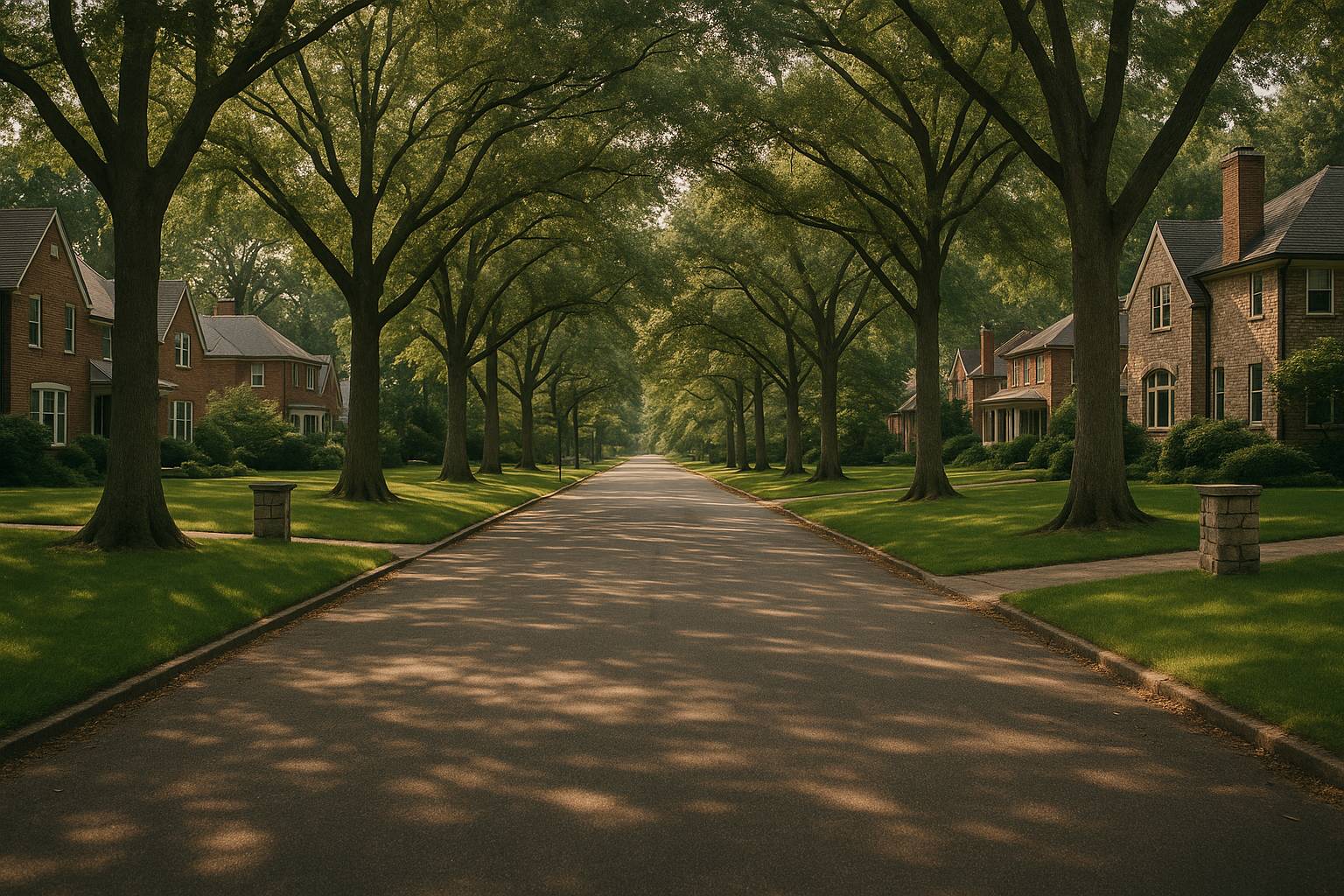
Ladue is a residential municipality of large lots and mature canopy with essentially no light industrial land, by design and by ordinance, and it has been that way for a very long time. There is no yard here for a roofing company to occupy, and if there were, the land would be far too valuable to put trucks on.
So the companies sit where the yards are: Fenton, Kirkwood, Maryland Heights, Earth City, the industrial corridors along the interstates. And then they drive. A crew working on a Ladue roof this morning very probably left a yard in Fenton at half past six.
The same holds for Creve Coeur, and for most of the affluent inner ring. It is not a comment on those towns. It is a comment on where trucks can be parked.
The consequence
Why this site does not rank "the best roofers in Ladue"
Because such a ranking cannot honestly be built. There are two ways to produce one and both are dishonest.
- Rank by registered address. The list comes back empty, so a page doing this has to loosen the radius until it fills, at which point it is a list of companies in other municipalities presented as a list of companies in this one. The reader is being shown a proximity artefact and told it is local knowledge.
- Rank by category label. Widen the category and the list fills immediately, mostly with gutter cleaning services, which in this market are pressure washers and window cleaning outfits carrying a roofing adjacent label. Presenting those as the best roofers in a town of slate and heavy architectural shingle is worse than useless.
So there is no ranking on this site. What there is instead is a set of articles about roofs on houses of this kind, and a phone number belonging to a company that will tell you what it does and does not do.
A pin in Fenton tells you where the trucks sleep. Nothing else.
What does correlate
Distance matters in exactly two ways
Having said all that, geography is not entirely meaningless. It matters in two narrow and practical senses, and it is worth separating them from the general claim that local is better.
- Coming back. The value of a nearby contractor is not the drive to the job, it is the drive to the callback. A small punch list item, a gutter that needs adjusting after the first heavy rain, a question two winters later: those get handled by a company whose service area genuinely includes you, and quietly do not get handled by one whose nearest other job is a hundred miles away.
- Knowing the municipality. A company that works this side of the county routinely knows what the building department wants, knows what the drives on these streets will and will not take, and knows which weeks of the year the trees make a mess of a valley. That is real local knowledge and it has nothing to do with a registered address.
Both of those are questions you can ask directly, and neither is answered by a map.
Instead
Four questions that beat a map pin
- Is my address inside your normal service area, or an outlier? Ask it plainly. A company that works the mid county corridor daily will say so without hesitating.
- Which municipality am I in and what does it require for this job? The single fastest test of whether somebody actually works here.
- Where are two roofs you finished more than five years ago that I could look at? Old work is the sample that matters.
- Who comes back if something needs adjusting after the first heavy rain? A name and a phone number, not a department.
Keys Roofing works across greater St. Louis, including Ladue, and does not office here for the reasons set out above. Roofing, gutters and downspouts, Atlas and Malarkey shingles, licensed and insured. What that scope covers in detail is in the work, and how to start it.
Elsewhere in this file
Article 02
What actually ages a roof hereFreeze and thaw working the same fastener in two directions across one year, and why the field of the roof is rarely what fails.
Article 03
Permits and the municipalityWhat St. Louis County requires, what a municipality can add on top of it, and the fact that Missouri issues no roofing licence at all.
Article 04
What a written scope containsFourteen things that belong on the page before anyone climbs a ladder, including the one number that always moves after the tear-off.
Article 05
Mature tree cover and the roofOak canopy is the reason to live here and it is also an abrasive, a dam, and a moisture trap. What it does and what it does not do.
Article 06
Matching an older roof honestlyMissouri has no matching law for roofs. What that means in practice, and how an honest contractor talks about a discontinued profile.
Article 07
Gutters and drainage on a large houseThe undersized gutter is the classic failure on a big steep roof, and it is almost always a sizing decision, not a workmanship one.
Article 08
How to vet a roofing contractorThe questions that actually separate one bid from another, and the four sales behaviours that should end a conversation.
Article 10
The storm record for this countyWhat the National Weather Service and NOAA actually logged, what those counts do and do not measure, and one Missouri tax credit that expires.
Article 11
The work, and how to start itRoofing, gutters and downspouts. What Keys does, what Keys does not do, and what happens after you call.