The core problem
A big steep roof concentrates water
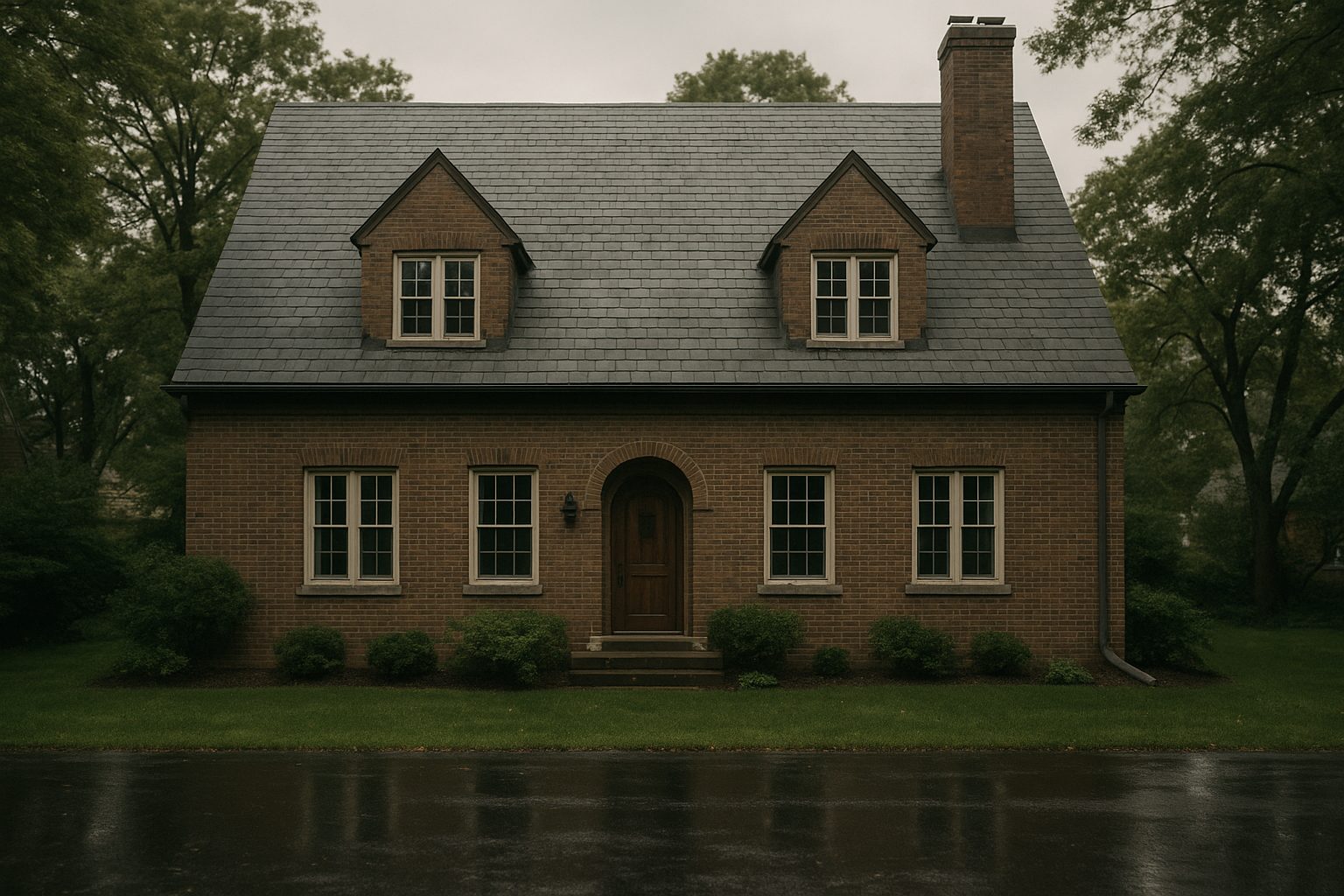
Think about what a gutter is being asked to do. Every square foot of roof plane above it sheds into it, and the water arrives at a speed set by the pitch. A large steep plane therefore delivers a large volume, quickly, into a relatively short length of eave. The gutter has to accept that flow at the lip, carry it laterally, and get it into a downspout before the next second's worth arrives.
Two independent things can fail there. The gutter can overflow because it cannot hold the volume, or the water can simply overshoot the gutter entirely, arriving off a steep plane with enough horizontal speed to fly straight over the outer lip. The second one is the one people misread, because it happens only in heavy rain and leaves a gutter that looks perfectly clean and correctly hung.
A gutter that looks fine in a drizzle and pours over the front lip in an April storm is undersized, not badly hung.
Sizing
Five inch, six inch, and why the default is wrong here
Five inch K style gutter is the residential default across the country. It is what is on the truck, it is what most crews hang without asking, and on a modest one storey house with gentle pitch it is entirely adequate.
A six inch gutter carries substantially more water than a five inch one, and it pairs with a larger downspout, which is where the real difference is: the downspout, not the trough, is usually the actual bottleneck. On a house with tall steep planes, long runs, valleys discharging into the middle of a run, and heavy tree litter, six inch is frequently the correct answer and five inch is frequently what is already there.
- Plane area
- How much roof drains into this specific run, not the whole house. A single steep plane can outweigh three small ones.
- Pitch
- The steeper the plane, the faster the water arrives at the lip and the more likely it is to overshoot rather than turn.
- Run length
- A long run with one outlet at the end is carrying the whole load past every foot of itself before it can leave.
- Valley discharge
- A valley concentrates two planes into one point. That point wants a downspout near it, not thirty feet away.
- Debris load
- Under mature canopy the effective cross section is smaller than the nominal one for most of the year.
Downspout count follows from the same arithmetic. Adding a second outlet to a long run is often a cheaper and more effective fix than replacing the trough, and it is the first thing worth checking on a run that overflows in one predictable spot.
Hanging
Seamless, hangers, and the pitch of the trough
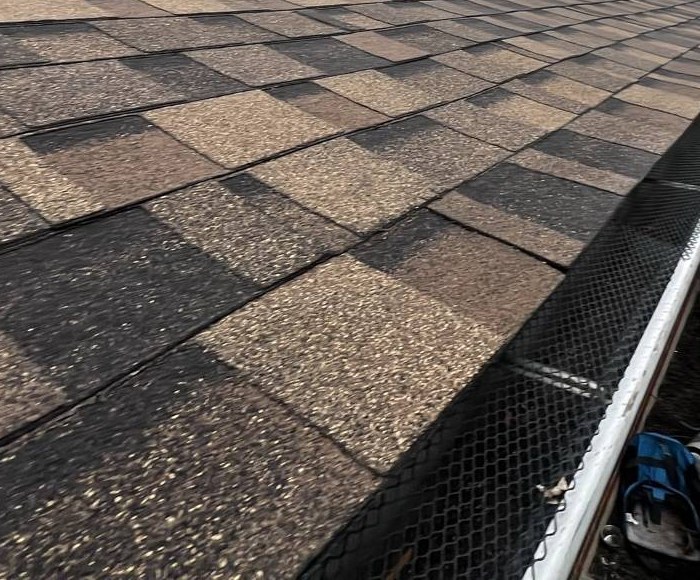
Seamless gutter is formed on site from a coil, run out to the exact length of the eave, so a straight run has no joint in it anywhere. Joints are where gutter leaks start, so removing them removes a whole category of failure. Corners and outlets are still joints and still need sealing properly, but a fifty foot run with no seam in the middle is a materially better piece of work than three sectional lengths lapped together.
Hangers matter next. Hidden hangers screwed into the fascia hold better than spike and ferrule, which was the older standard and which works loose over exactly the same freeze and thaw cycles that back a roofing nail out. Spacing tightens where snow load or debris load is heavier, and a gutter that is sagging between hangers is holding standing water, which is heavy, which sags it further.
Then pitch. A gutter is not level. It falls toward its outlet at a slight, deliberate slope, and a run that has been hung dead level looks perfect and drains badly. On a long run with a downspout at each end, the high point sits in the middle. This is the sort of detail that is invisible on the day and obvious two years later.
Where it goes
The part most roofing companies stop before
Getting water into a downspout is only half the job. Where the downspout puts it decides whether the roof drainage protects the house or attacks it. A downspout discharging at the base of the wall on a large old house is delivering a very large volume of water directly into the soil against the foundation, repeatedly, for years.
- Extensions. The simplest fix. Get the discharge point away from the wall and onto ground that falls away from the house.
- Reroutes. Moving an outlet so the discharge does not land on a walk, a patio, a step or a planting bed that then holds it against the house.
- Underground carry. Solid pipe taking the discharge well away from the structure to daylight or to an approved point. On a house with a finished lower level this is often the correct answer, and it is the part of the work Keys does that most roofing companies do not.
- Grade. Worth saying even though it is not roofing: if the ground falls toward the house, no amount of gutter work will fix a wet basement. That is a landscape and drainage question and it deserves an honest answer rather than a gutter sale.
Old underground drainage lines on properties of this age are frequently clay tile, frequently root filled, and frequently discharging into something nobody living has ever seen. A downspout connected to a blocked underground line performs worse than one discharging onto the lawn, because the water backs up and delivers itself to the foundation under a small head of pressure.
Guards
What a guard can and cannot do
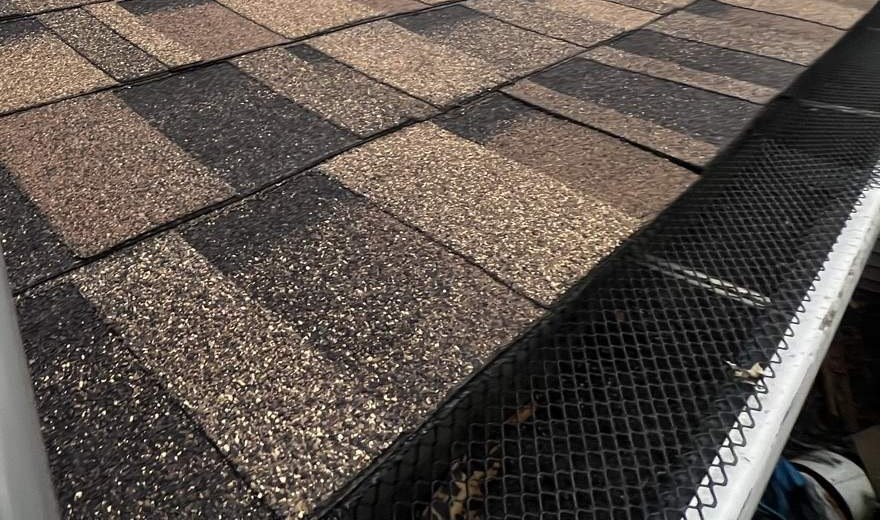
Gutter guards are worth having under mature canopy and they are routinely oversold. A good guard keeps a gutter passing water through an oak spring, which is genuinely valuable given that the spring debris load and the heaviest rainfall of the year arrive in the same weeks. What a guard does not do is end maintenance. Fine material still collects on top of a guard, particularly under a valley discharge, and a guard covered in a compacted mat of catkins sheds water off the front of the gutter just as effectively as a blocked trough would.
Treat a guard as a filter with a service interval, not a lid you install once. Any product sold on the promise that you will never look at the gutter again is being sold on a claim that the debris in this metro does not support.
What the trees actually drop, and when, is set out in mature tree cover and what it does to a roof.
Elsewhere in this file
Article 02
What actually ages a roof hereFreeze and thaw working the same fastener in two directions across one year, and why the field of the roof is rarely what fails.
Article 03
Permits and the municipalityWhat St. Louis County requires, what a municipality can add on top of it, and the fact that Missouri issues no roofing licence at all.
Article 04
What a written scope containsFourteen things that belong on the page before anyone climbs a ladder, including the one number that always moves after the tear-off.
Article 05
Mature tree cover and the roofOak canopy is the reason to live here and it is also an abrasive, a dam, and a moisture trap. What it does and what it does not do.
Article 06
Matching an older roof honestlyMissouri has no matching law for roofs. What that means in practice, and how an honest contractor talks about a discontinued profile.
Article 08
How to vet a roofing contractorThe questions that actually separate one bid from another, and the four sales behaviours that should end a conversation.
Article 09
Where a roofer is registeredThere is no roofing company with a registered address in Ladue. That fact is worth understanding rather than hiding.
Article 10
The storm record for this countyWhat the National Weather Service and NOAA actually logged, what those counts do and do not measure, and one Missouri tax credit that expires.
Article 11
The work, and how to start itRoofing, gutters and downspouts. What Keys does, what Keys does not do, and what happens after you call.