Abrasion
Branches do not need to break anything
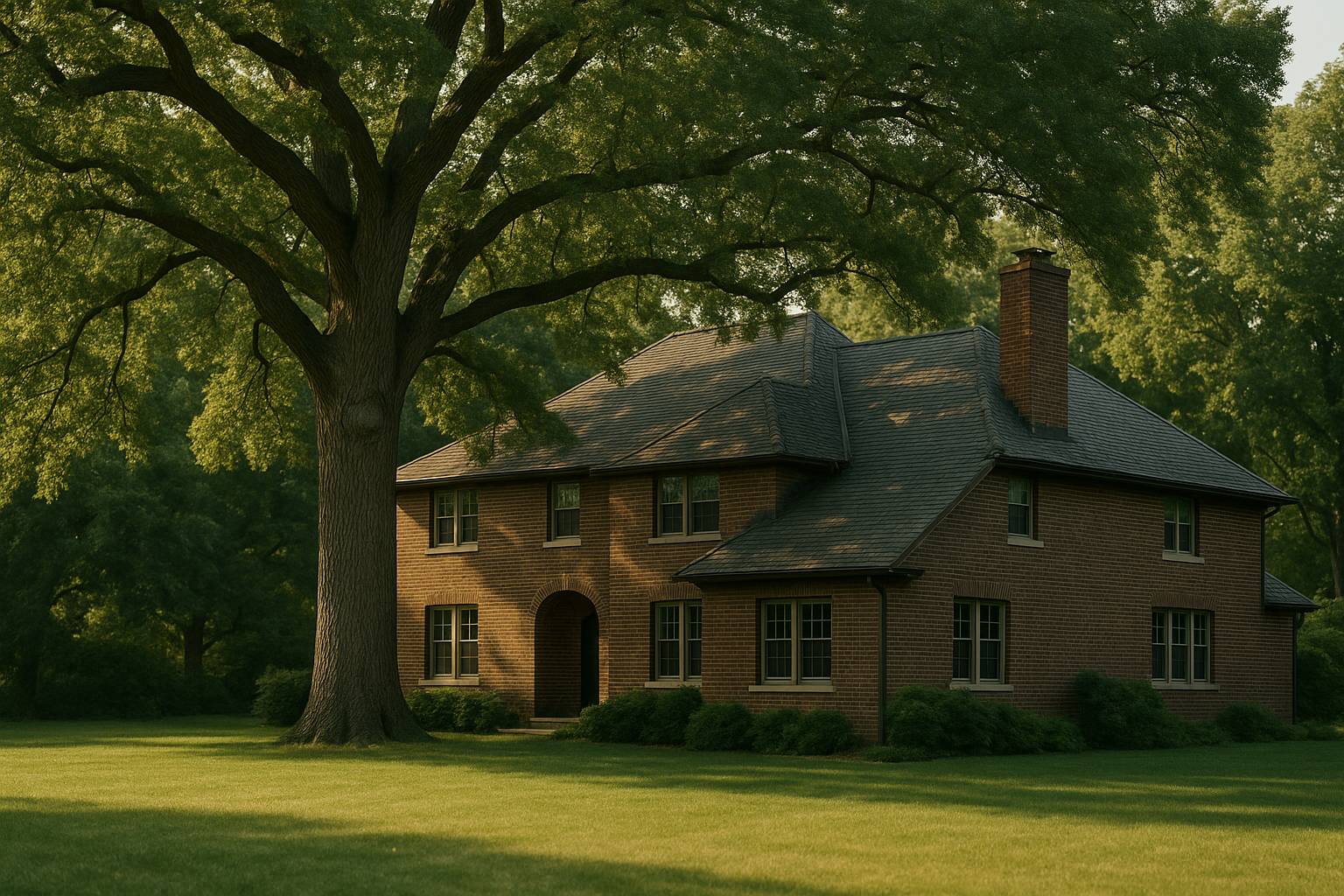
A limb resting on or near a roof does not have to fall to do damage. In wind it sweeps, and a branch sweeping across an asphalt shingle for a decade is a slow grinder. It takes the granules off. Granules are not decoration: they are the ultraviolet shield for the asphalt underneath, and a shingle that has been swept clean in a line is ageing several times faster along that line than anywhere else on the roof.
You will see it as a pale stripe or an arc, usually on the windward face, usually starting a few feet in from an edge. Under it, the mat is exposed. Left long enough, that arc is where the roof begins to fail, and it will fail in a shape that makes the cause obvious.
Clearance is the fix, and the number most arborists work to is a few feet of air between the crown and the roof plane. On a protected canopy in a town with tree ordinances, that is a conversation with an arborist rather than a decision made from a ladder. It is worth having before the roof is replaced rather than after.
Debris load
What actually comes down, and when
Deciduous canopy in this metro produces four distinct debris events across the year, and only one of them is the one people plan for.
- Spring. Oak catkins and maple samaras. Small, fibrous, and very good at packing into a gutter and a valley. This is the load that most often blinds a downspout, and it arrives in the same weeks as the heaviest rain of the year.
- Summer. Twig and small limb fall from storms, plus the steady shed of a stressed tree in a dry August.
- Autumn. The obvious one. Volume, but relatively easy to remove.
- Winter. Whatever the autumn left, now wet, compacted and frozen into a solid mass in the low end of the gutter.
The consequence is that a house under mature canopy needs the gutters cleared more than once a year, and the spring clearing matters more than the autumn one, which is the reverse of how most people schedule it.
Moisture
Shade, and the black streaks
The third effect is that shaded roof planes stay wet longer after rain, and a roof plane that never fully dries grows things. The dark streaking on a north facing plane is generally an algae, and it is cosmetic rather than structural. It does not eat the shingle. It does make the plane look a decade older than the plane on the other side of the ridge, which is why a homeowner will often be told the roof is finished when what is actually happening is that half of it needs washing.
Moss is a different matter and worth taking seriously. Moss holds water directly against the shingle and works its way under the course above, lifting it. On a shaded plane under heavy canopy in this climate, moss is a genuine reason to intervene, and the intervention is gentle. Pressure washing an asphalt roof removes granules wholesale and takes years off it in an afternoon.
Algae is a cosmetic problem. Moss is a mechanical one.
Gutters
Where canopy and drainage collide
Everything above lands in the gutter. On a large house under old trees, the gutter is being asked to carry a heavy volume of water and a continuous load of organic material through the same channel, and those two requirements pull in opposite directions.
Three things follow from that, and they are the practical decisions worth making deliberately:
- Size for the water, not for the leaves. A six inch gutter with a larger downspout passes more debris before it blocks, purely because the cross section is bigger. It is also what a big steep roof needs anyway.
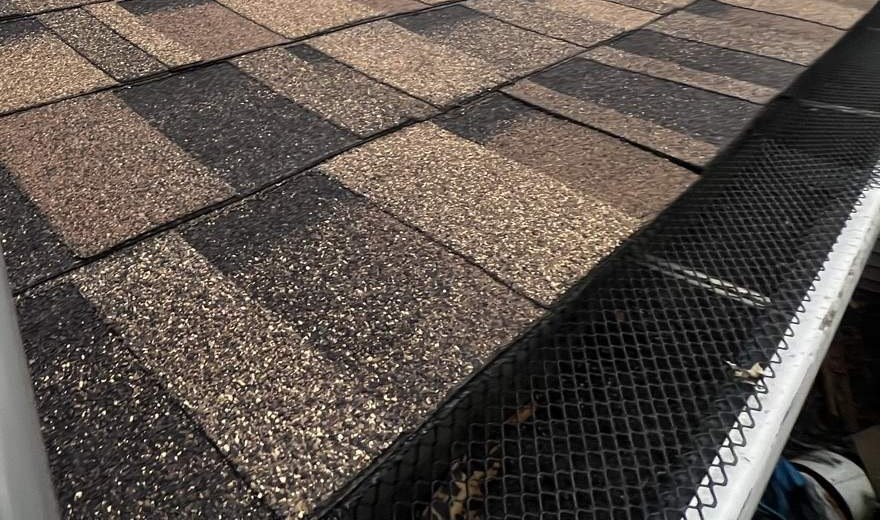
- Guards are a filter, not a lid. A good guard keeps the gutter passing through an oak spring. It does not end maintenance, and any product sold on the promise that it does is overselling. Fine debris still needs clearing off the top of a guard, particularly where it sits under a valley discharge.
- Watch the valley outlets. A valley dumps the water off two planes into a short length of gutter. That is the spot that overflows first, it is usually above a door or a walk, and it is the point where a downspout most often belongs.
The sizing argument in full is in gutters and drainage on a large house, which is the article most relevant to a house of this size under this much canopy.
One thing it does well
The shade is genuinely worth something
For balance: canopy shade lowers the deck temperature, and deck temperature drives the ageing described in what actually ages a roof here. A shaded roof plane in this climate is doing less thermal cycling than an exposed one, and that is real. The trade is that it dries slower and carries more debris.
Nobody should remove a mature oak to protect a roof. The point of this article is narrower: a house under old trees needs its valleys, gutters and shaded planes looked at on a schedule, and the schedule is not the same as the one for a house on an open lot.
Elsewhere in this file
Article 02
What actually ages a roof hereFreeze and thaw working the same fastener in two directions across one year, and why the field of the roof is rarely what fails.
Article 03
Permits and the municipalityWhat St. Louis County requires, what a municipality can add on top of it, and the fact that Missouri issues no roofing licence at all.
Article 04
What a written scope containsFourteen things that belong on the page before anyone climbs a ladder, including the one number that always moves after the tear-off.
Article 06
Matching an older roof honestlyMissouri has no matching law for roofs. What that means in practice, and how an honest contractor talks about a discontinued profile.
Article 07
Gutters and drainage on a large houseThe undersized gutter is the classic failure on a big steep roof, and it is almost always a sizing decision, not a workmanship one.
Article 08
How to vet a roofing contractorThe questions that actually separate one bid from another, and the four sales behaviours that should end a conversation.
Article 09
Where a roofer is registeredThere is no roofing company with a registered address in Ladue. That fact is worth understanding rather than hiding.
Article 10
The storm record for this countyWhat the National Weather Service and NOAA actually logged, what those counts do and do not measure, and one Missouri tax credit that expires.
Article 11
The work, and how to start itRoofing, gutters and downspouts. What Keys does, what Keys does not do, and what happens after you call.