The state layer
Missouri does not license roofers
This surprises people, and it should. Missouri has no state roofing licence and no state roofing registry. The legislature has been asked three times to create one. Senate Bill 1022 in 2016, Senate Bill 153 in 2019 and Senate Bill 326 in 2021 each proposed a statewide licensing scheme, and all three failed to become law. SB 326 in particular circulates on contractor blogs as though it passed. It did not.
What Missouri does regulate is conduct. RSMo chapter 407, the Merchandising Practices Act, applies to roofing contractors like any other trade, and section 407.725 adds rules specific to residential roofing after a storm. That is enforcement after the fact rather than screening in advance, and the practical consequence is that the screening is yours to do.
Read this if a salesperson mentions a licence number
There is no state number to give you. If a company shows you a number, ask which municipality issued it and for which year, then ask whether that municipality is yours. Municipal contractor registration is real and worth checking. A state roofing licence is not a thing that exists in Missouri.
The county baseline
What St. Louis County requires
The county rule is the reference point that most of the metro works from, and it is worth knowing even where it does not directly govern, because municipal codes tend to be written against it.
In unincorporated St. Louis County, a straight like for like asphalt replacement on a slope of 4:12 or steeper does not require a permit. A permit is required if the slope is shallower than 4:12, if more than a quarter of the sheathing is being replaced, or if the roofing material is changing. Each of those three triggers matters more on an older house than on a new one.
- Slope. Porch roofs, dormer cheeks, additions and sun room roofs on houses of this vintage are frequently below 4:12 even when the main planes are steep. One low slope section brings the whole job into permit territory.
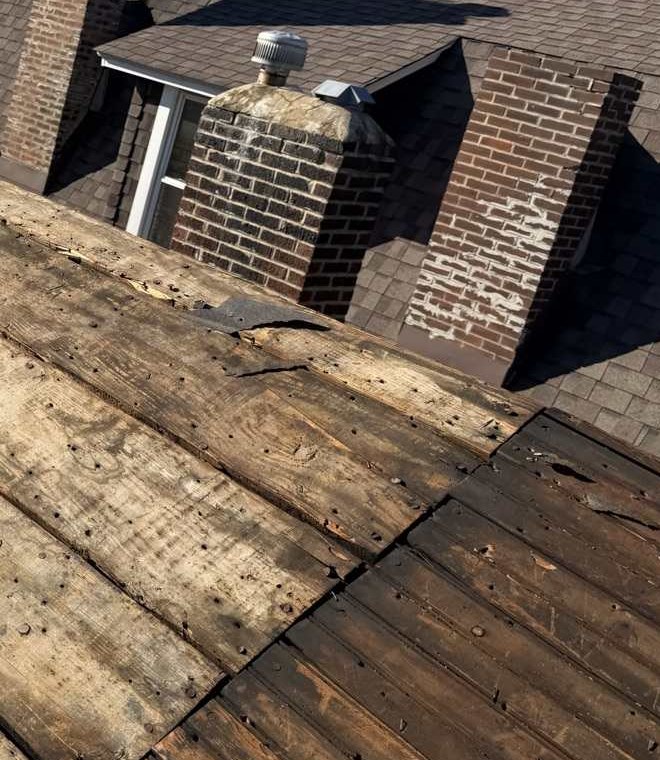
- Decking. Nobody knows how much of the deck is bad until the old roof is off. Cross the quarter threshold and the job needs a permit it did not need that morning.
- Material change. Slate or tile to architectural shingle is a material change. So is a change in the low slope system on a flat porch.
The municipal layer
Ladue is its own authority
Ladue is an incorporated municipality with its own building department, which means the municipal code governs and the county baseline is context rather than law for your house. Confirm the requirement with the city before the dumpster is delivered, not after. Elsewhere in the county the picture varies genuinely: several municipalities, Ballwin and Kirkwood among them, operate their own contractor licensing rather than deferring to the county, so a contractor who is registered to work in one town may not be registered in the next.
Municipal process on a street of large lots and mature trees also tends to carry practical conditions that have nothing to do with the roof itself: where the dumpster may sit, what hours work may start, protection of the right of way, and whether the drive can take the weight of a loaded delivery truck. On this kind of property the answer to that last one is often no, and a company that has not thought about it will find out with a boom truck in your lawn.
The useful question
Ask a bidder which municipality your house is in and what that municipality requires for this job. It is a trivial question for anyone who works here regularly and a genuinely hard one for a crew that came in for the storm season.
Who pulls it
The permit is the contractor's job to pull
Where a permit is required, the contractor pulls it. A homeowner who is asked to pull an owner permit so the crew can start sooner is being asked to take on the liability that a licensed and insured contractor is supposed to carry, and it is one of the clearer warning signs in this trade.
Two related things belong in the same conversation. First, proof of general liability and workers compensation coverage, sent from the insurer or the agent rather than as a photograph of a certificate. Second, the name on the permit should be the name on the contract and the name on the truck. Where those three differ, ask why before work starts rather than after.
More of that in how to vet a roofing contractor, and the paperwork side in what a written scope contains.
Elsewhere in this file
Article 02
What actually ages a roof hereFreeze and thaw working the same fastener in two directions across one year, and why the field of the roof is rarely what fails.
Article 04
What a written scope containsFourteen things that belong on the page before anyone climbs a ladder, including the one number that always moves after the tear-off.
Article 05
Mature tree cover and the roofOak canopy is the reason to live here and it is also an abrasive, a dam, and a moisture trap. What it does and what it does not do.
Article 06
Matching an older roof honestlyMissouri has no matching law for roofs. What that means in practice, and how an honest contractor talks about a discontinued profile.
Article 07
Gutters and drainage on a large houseThe undersized gutter is the classic failure on a big steep roof, and it is almost always a sizing decision, not a workmanship one.
Article 08
How to vet a roofing contractorThe questions that actually separate one bid from another, and the four sales behaviours that should end a conversation.
Article 09
Where a roofer is registeredThere is no roofing company with a registered address in Ladue. That fact is worth understanding rather than hiding.
Article 10
The storm record for this countyWhat the National Weather Service and NOAA actually logged, what those counts do and do not measure, and one Missouri tax credit that expires.
Article 11
The work, and how to start itRoofing, gutters and downspouts. What Keys does, what Keys does not do, and what happens after you call.