Amplitude
The same fastener, pulled two ways in one year
St. Louis has a continental swing. The deck under a dark roof in this county will sit well above ambient on an August afternoon and then drop below freezing repeatedly through the winter, and it does that year after year. Wood, steel and asphalt all respond to that swing, but they do not respond at the same rate or at the same time.
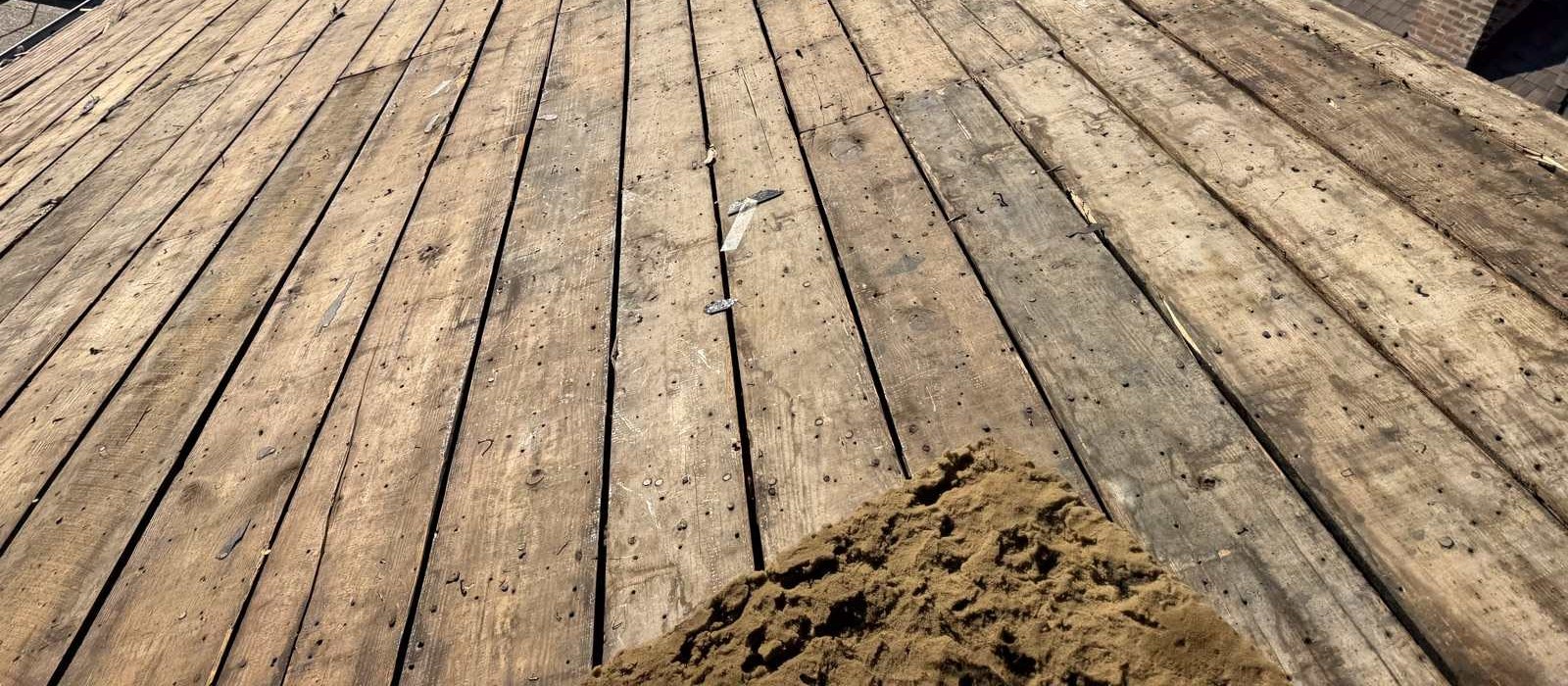
A roofing nail is driven through asphalt into sheathing. Heat the assembly and the deck swells; freeze it and the deck shrinks. The nail is the only rigid thing in the sandwich, so the movement is taken out on the nail. Repeat it a few thousand times over a decade and the nail walks upward a fraction at a time. Eventually the head lifts the shingle above it into a small tent, and the shaft has left a hole in the deck that is no longer sealed by anything.
That is a nail pop. It is invisible from the ground, it is trivially repairable on the day, and it is the single most common defect found on an otherwise healthy roof of this age.
Water
Freeze and thaw at the seams
The second mechanism is water finding a seam, freezing in it, and levering it open. Water expands when it freezes. A seam that was tight in October is a hair wider in March, and a hair wider again the March after that. This is why sealed details do not stay sealed and why a bead of roofing cement is a repair with a shelf life rather than a fix.
Ice dams are the visible version of the same thing. Heat escaping through an under insulated ceiling melts snow on the upper part of the roof, the meltwater runs down to the cold overhang, refreezes there, and builds a ridge of ice that backs standing water up under the shingle courses. Shingles shed water. They do not hold back a pond, and they were never designed to. On a house with deep overhangs and a complicated roof line, which describes most of this town, the dam forms in the same three places every winter.
The defence is not a better shingle. It is ice and water membrane at the eaves and the valleys, ventilation that keeps the deck cold, and insulation that stops the heat reaching it in the first place.
Ultraviolet
The parts that are rubber
Sunlight breaks down every flexible component on a roof, and a roof has more of them than most people expect. The collar on a plumbing vent boot is rubber. Pipe seals, some flashing gaskets and any exposed sealant are all polymer of one kind or another, and all of them harden, shrink and split under enough ultraviolet.
The failure sequence is predictable. The collar splits at the top of the stack, water follows the pipe down into the attic, and it does not appear on a ceiling until it has run along a joist far enough to find a soft spot in the plaster. By then the stain is nowhere near the actual hole, which is exactly why homeowners are so often told the whole roof is finished when a boot has failed.
A ceiling stain is the last place to look for the leak.
Ventilation
What is happening underneath
A roof is cooled from below or it is not cooled at all. Intake at the soffit, exhaust at the ridge, and a clear path between the two: that is the whole system. Older houses in this area were built before continuous ridge venting was normal, so many of them are working on box vents, gable vents, or nothing at all, and quite a few have had insulation blown into the eaves at some point in the last forty years, which closes off the intake and leaves the exhaust pulling against a sealed box.
An unventilated deck runs hotter, which accelerates every mechanism above. It also holds moisture, and moisture in a cold attic condenses on the underside of the sheathing and rots it from the inside. Decking replaced during a tear off on a house like that is often perfectly sound from above and delaminating from below.
This matters when you read a bid. Two proposals for the same house can differ by a large number simply because one of them addressed intake and the other did not, and the cheaper one will look identical from the street for about six years.
The conclusion
Details fail. Surfaces mostly do not.
Put the four mechanisms together and a pattern falls out that holds on nearly every older house here. Fasteners work loose. Seams open. Rubber splits. The deck cooks. All four of those happen at the transitions: penetrations, valleys, chimneys, sidewalls, eaves and ridge. The open field of the roof, which is the part everybody photographs, is generally the last thing to go.
Which is why an honest assessment of a roof in this town is mostly a list of details, with a note on the field, rather than the other way around. And it is why what a written scope contains is the most useful thing on this site if you are about to spend real money.
If you would like the roof looked at rather than described, that is what Keys does: photographs, measurements, and a written scope you keep whether or not you use us.
Elsewhere in this file
Article 03
Permits and the municipalityWhat St. Louis County requires, what a municipality can add on top of it, and the fact that Missouri issues no roofing licence at all.
Article 04
What a written scope containsFourteen things that belong on the page before anyone climbs a ladder, including the one number that always moves after the tear-off.
Article 05
Mature tree cover and the roofOak canopy is the reason to live here and it is also an abrasive, a dam, and a moisture trap. What it does and what it does not do.
Article 06
Matching an older roof honestlyMissouri has no matching law for roofs. What that means in practice, and how an honest contractor talks about a discontinued profile.
Article 07
Gutters and drainage on a large houseThe undersized gutter is the classic failure on a big steep roof, and it is almost always a sizing decision, not a workmanship one.
Article 08
How to vet a roofing contractorThe questions that actually separate one bid from another, and the four sales behaviours that should end a conversation.
Article 09
Where a roofer is registeredThere is no roofing company with a registered address in Ladue. That fact is worth understanding rather than hiding.
Article 10
The storm record for this countyWhat the National Weather Service and NOAA actually logged, what those counts do and do not measure, and one Missouri tax credit that expires.
Article 11
The work, and how to start itRoofing, gutters and downspouts. What Keys does, what Keys does not do, and what happens after you call.